Tidal Disruption Events
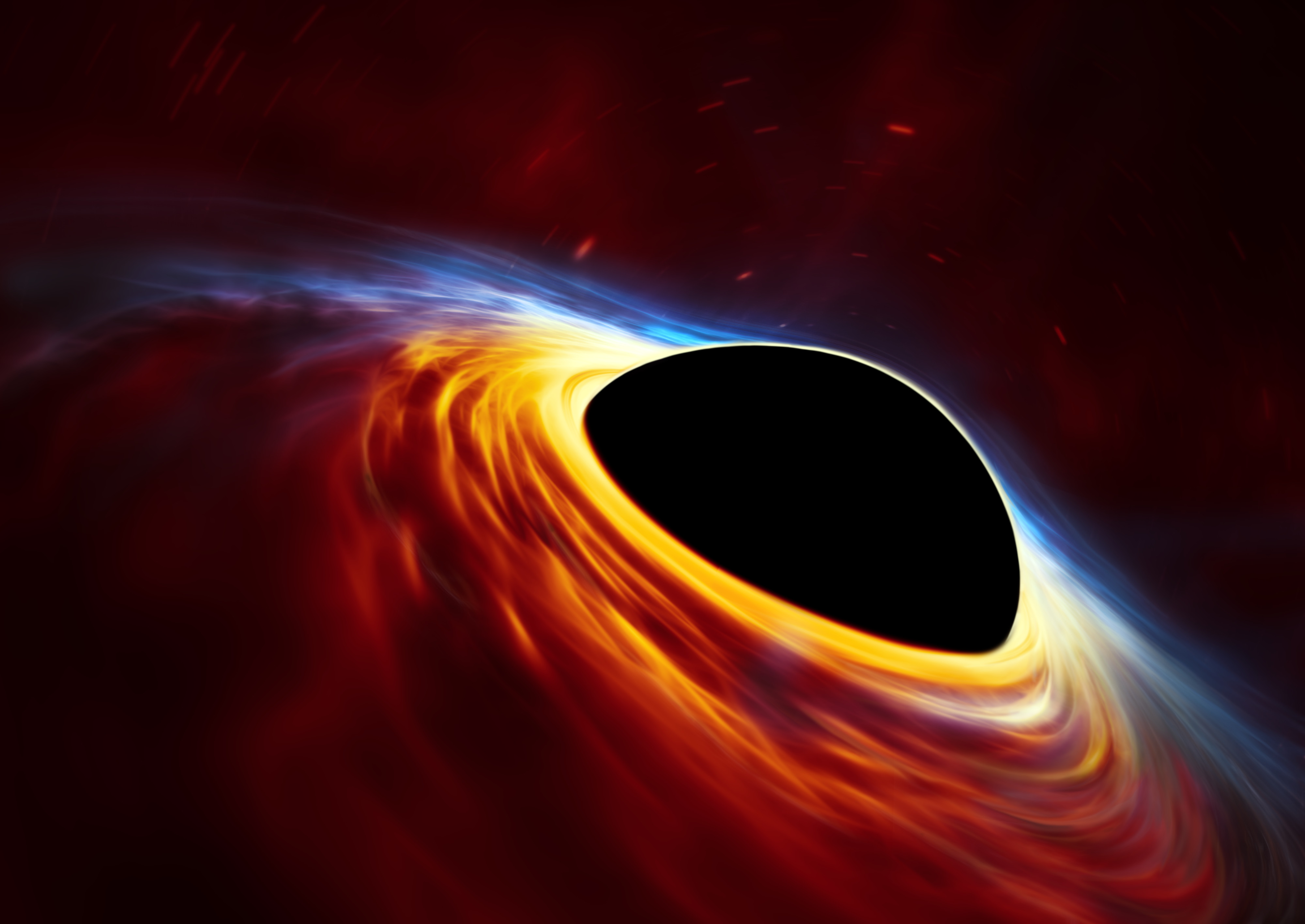
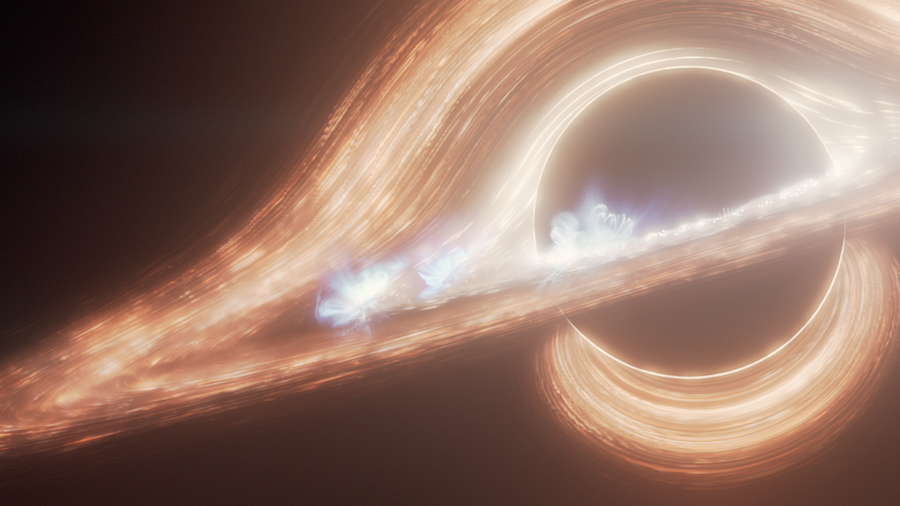
At the centre of almost every galaxy lies a supermassive black hole. The gravitational field of these black holes is so strong that it can deform and eventually disrupt an entire star if it comes too close. This phenomenon is known as a tidal disruption event (TDE). TDEs are extremely violent phenomena and release an enormous amount of energy. Over the last decade, there has been significant interest in, and rapid progress on, the study of TDEs. Below, you can read about some of my selected contributions to this field.
Selected results
A new kind of TDE
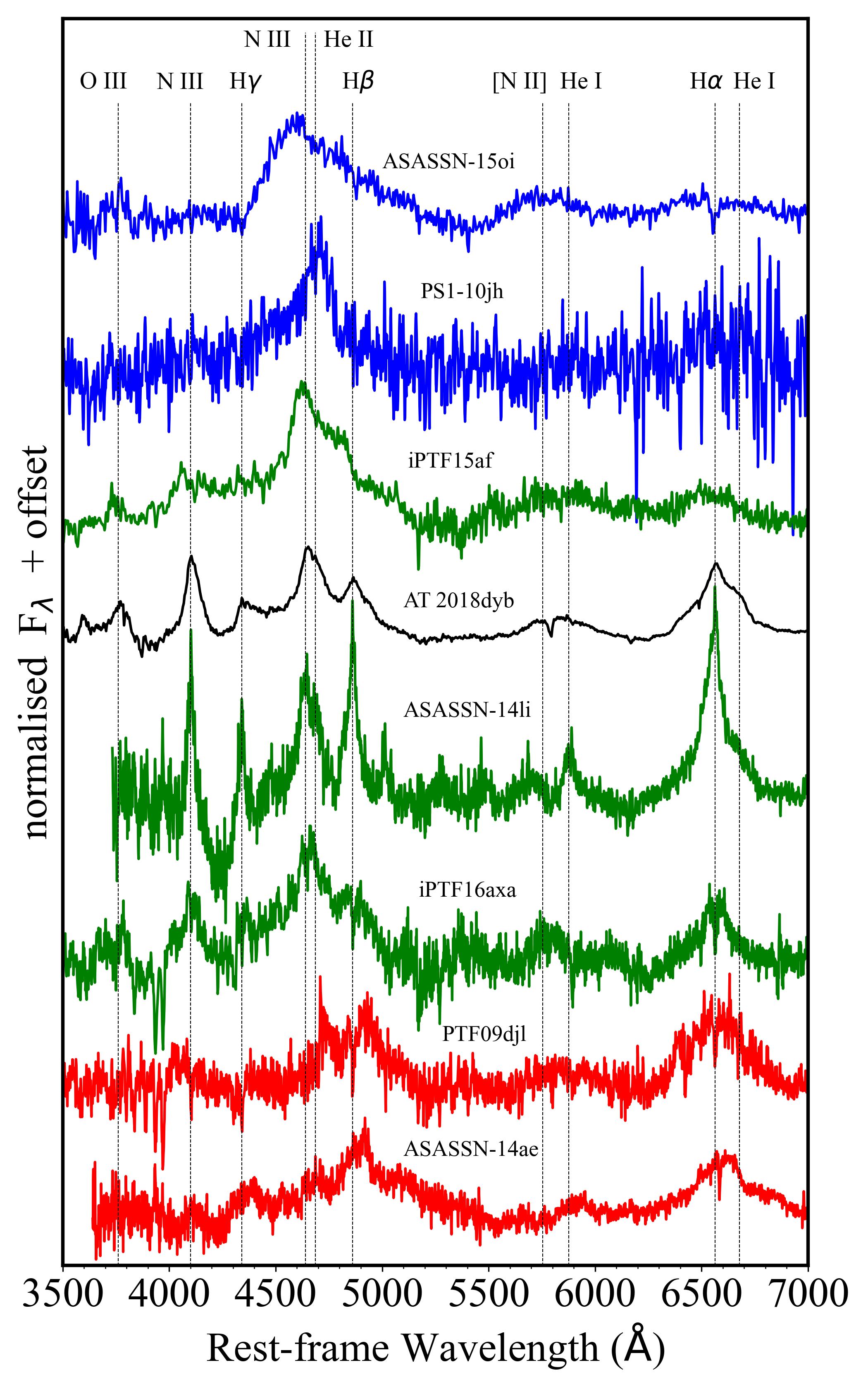
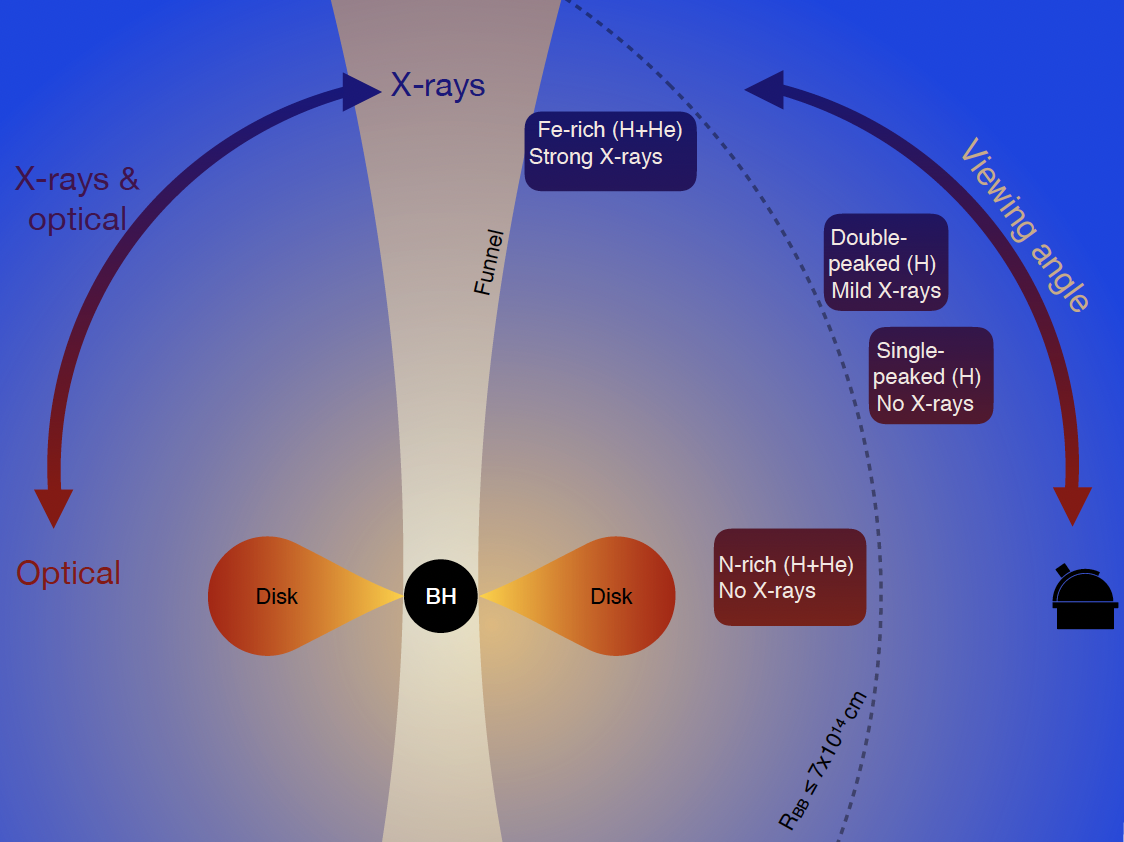
In a publication from 2019, I showed that the spectral and chemical diversity of TDEs is larger than previously thought. This study demonstrated that a large fraction of TDEs (those with green spectra in the figure to the right) commonly show nitrogen and oxygen lines, and not only hydrogen and helium. These features are identified as Bowen fluorescence lines. This result is important because the Bowen mechanism requires a hidden X-ray/extreme-UV source of photons. The presence of these lines therefore provides strong evidence for ongoing accretion even in optical TDEs where X-rays are not directly observed. In other words, X-rays are present but are reprocessed into lower-energy emission.
Polarimetry of TDEs
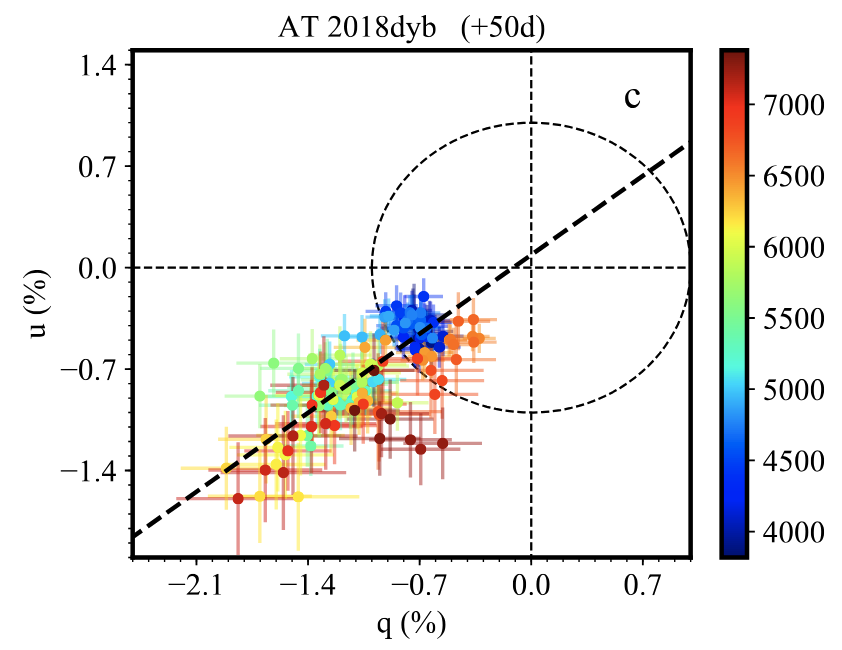
In my paper An asymmetric electron-scattering photosphere around optical tidal disruption events, published in Nature Astronomy, I studied TDEs using polarized light. Spectropolarimetry is a powerful technique that allows one to probe both the geometry and the physical mechanisms powering transient phenomena. This study showed that TDEs are surrounded by an envelope rich in free electrons, strongly favouring the reprocessing scenario for the origin of the optical emission. A follow-up study based on a much larger sample has since been published by my PhD student, Hannah Wichern.
Spectroscopy of TDEs
In a project led by my former PhD student Panos Charalampopoulos, we conducted the first systematic and detailed spectroscopic study of TDEs. This made it possible to focus on sample properties such as line widths, velocity offsets, and luminosities, as well as line ratios (for example He II to Hα, or He II to He I), their dependence on TDE temperature and radius, and their evolution with time. In addition, this study showed that time lags (light echoes) between the spectral lines and the continuum are common in TDEs. This work remains the only comprehensive sample study of TDE spectra to date.
The galaxies hosting TDEs
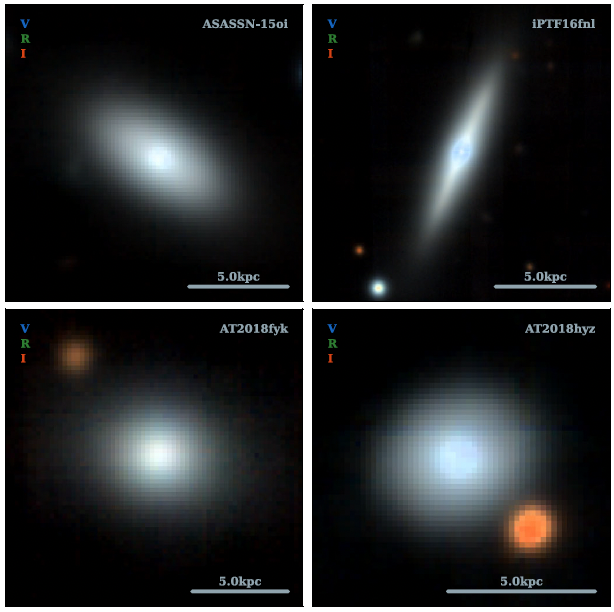
In a study led by my former postdoc Miika Pursiainen, we investigated a large sample of TDE host galaxies using IFU spectroscopy. This allowed us to study and model the stellar populations in the nuclear regions of the hosts, as well as the distribution of stellar masses that can be disrupted outside the black hole event horizon. We thus confirmed observationally that sub-solar-mass stars are far more likely to produce TDEs than solar-mass stars. Interestingly, the cases where higher stellar masses were favoured were associated with multi-peaked TDEs. The youngest stellar populations in the vicinity of TDE-associated black holes have ages that peak around one billion years, indicating that these environments are relatively old.
The extremely luminous ASASSN-15lh
ASASSN-15lh was a transient discovered in 2015 that was so luminous it challenged all existing models for stellar explosions, including those of superluminous supernovae. Our study instead proposed that this event was an extreme TDE, a scenario consistent with both its location and its observed properties. There was, however, a catch: the black hole had to be so massive that it would normally swallow the star whole rather than disrupt it outside its event horizon. For the TDE scenario to work, the black hole had to be rapidly spinning. This study was published in the first issue of Nature Astronomy and attracted substantial attention in the media.